TL;DR — Overview
Steel grating is a robust open-grid structural assembly composed of bearing bars and cross bars joined via welding or pressure locking. Essential for industrial flooring, trench covers, and walkways, it offers high load-bearing capacity and durability. The market is dominated by hot-dip galvanized carbon steel for general use, while specialized options like stainless steel and FRP cater to corrosive environments. Key types include welded, press-locked, and heavy-duty configurations. Prices vary significantly by channel: retail units for home use often range from $30 to $140, whereas industrial wholesale sourcing can see bulk rates between $785 and $1,000 per ton.
Illustration
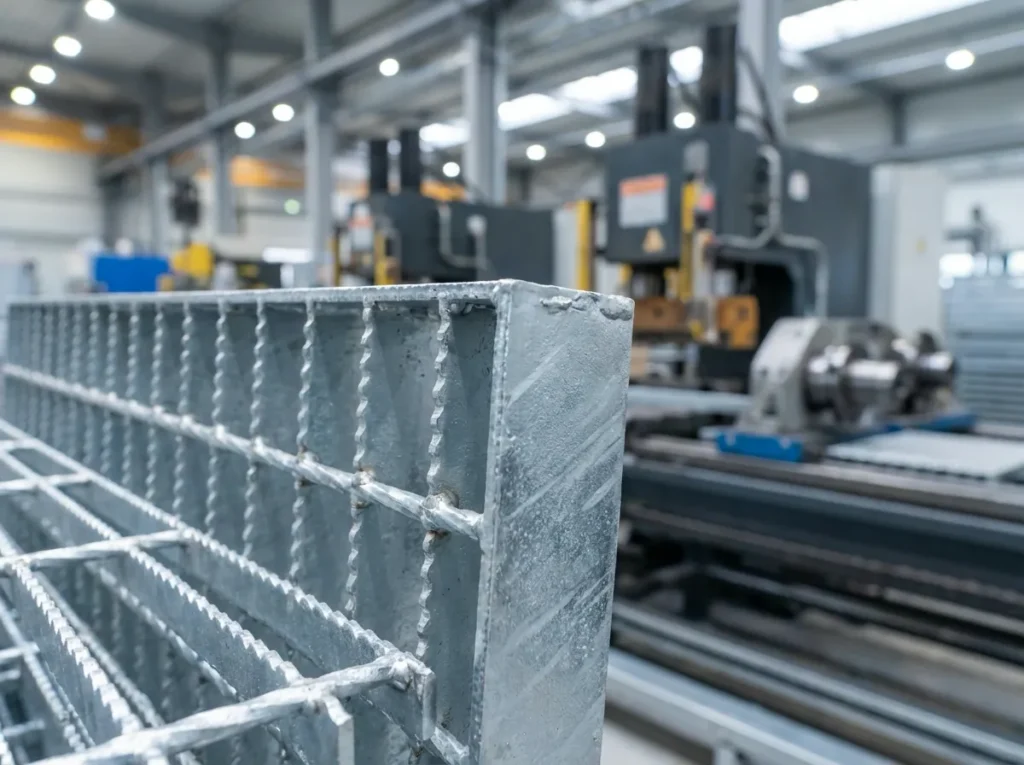
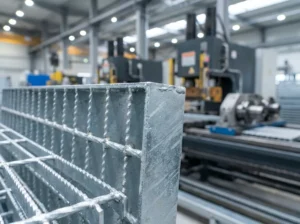
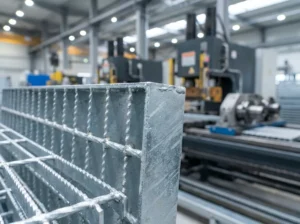
Close-up of a galvanized serrated steel grating panel featuring press-welded joints, set against a blurred industrial factory background.
What is Steel Grating?
Steel grating is an open-grid metal panel formed by a series of parallel bearing bars (which carry the main load) and perpendicular cross bars (which provide stability). This lattice structure creates a surface that is both lightweight and incredibly strong, allowing for the free passage of light, air, and liquids. Unlike expanded metal or perforated plates, which are formed from a single sheet, steel grating’s bar-assembly design offers superior load-bearing capabilities for heavy-duty applications.
In the retail market, smaller grating units are popular for residential drainage and garage utility. For example, a 12-inch galvanized drain grate typically retails around $39.99, offering a durable solution for driveway water management. These consumer-grade products highlight the material’s versatility, scaling from simple backyard drains to massive industrial platforms.
Types and Specifications
Industrial grating comes in several distinct configurations, each suited to specific load and aesthetic requirements.
| Welded GratingThe most common type, where cross bars are electrically forged to bearing bars. It is economical and robust. Common specs include the 19w4 specification (19-gauge bearing bars, 4-gauge cross bars) often used in industrial walkways. | Press-Locked & SerratedPress-locked grating relies on hydraulic pressure to bond the bars, offering a cleaner look for architectural use. Serrated surfaces are critical for safety in oily or wet environments, providing superior slip resistance. |
Material selection is equally critical. Carbon Steel with hot-dip galvanizing is the industry standard for general outdoor use. For hygiene-critical or highly corrosive areas, Stainless rSteel (304/316) is preferred, though more expensive. Aluminum offers a lightweight alternative, while FRP (Fiberglass Reinforced Plastic) is used where non-conductivity is required. Heavy-duty variants are available for areas supporting vehicle traffic, often priced individually, such as $9.90–$18.90 per piece for smaller industrial segments.
Manufacturing and Quality Control
The manufacturing of high-quality steel grating follows a rigorous ISO-managed process to ensure structural integrity and longevity.
Raw Material Inspection: Verification of steel grade (typically Q235 or ASTM A36) and thickness tolerances.
Press-Welding: Automated high-voltage resistance welding fuses cross bars to bearing bars, creating a single unit without filler metal.
Fabrication: Cutting, banding, and straightening the panels to exact dimensions.
Surface Treatment: Hot-dip galvanizing (ASTM A123) immerses the steel in molten zinc, providing decades of rust protection.
Applications and Benefits
Steel grating’s versatility allows it to bridge the gap between heavy industry and civil engineering.
Industrial Use: It is indispensable in sectors like oil & gas, mining, and wastewater treatment. Platforms like oil rig walkways rely on serrated grating for anti-slip safety and drainage. The open design prevents the accumulation of hazardous liquids or debris.
Civil & Commercial Use: In urban environments, it serves as durable drainage covers and ventilation grilles. Retail solutions are readily available, such as heavy-duty 20×40 inch sewer grates priced around $139.00, which are rated for vehicle traffic in garages and driveways.
Pricing and Sourcing
Sourcing steel grating involves navigating a wide price disparity between retail convenience and wholesale volume.
| Channel | Typical Price Range | Best For | Key Driver |
| Direct Manufacturer | $10 – $22 per sqm | Custom specs, Large industrial | Labor & Galvanizing costs |
Pricing is heavily influenced by the zinc thickness (galvanizing quality), bar depth, and load class. For international buyers, terms are typically FOB (Free On Board) from major export hubs like Tianjin Xingang. Payment often requires a T/T deposit, with the balance due upon shipment.
Design Principles
Effective grating design starts with defining the Load Class. A pedestrian walkway requires significantly less bearing strength than a forklift aisle. Designers must calculate the Span—the unsupported distance the grating covers—as this dictates the required depth of the bearing bars. A deeper bar increases load capacity but raises costs.
Other critical inputs for same-day CAD drawings include:
- Environmental Conditions: Wet/Oily areas require serrated bars; corrosive areas need stainless steel or FRP.
- Finishing: Edge banding welds the open ends of the panel, improving rigidity and safety.
- Aesthetics: Press-locked grating is often chosen for architectural facades due to its clean lines.
Installation Essentials
Proper installation is the final step to ensuring safety. Common mistakes include insufficient support width or incorrect orientation of bearing bars.
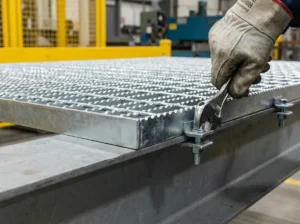
| Installation ChecklistOrientation: Bearing bars MUST span perpendicular to the supports. Cross bars do not carry load.Support: Ensure a minimum of 25 mm (1 inch) of bearing support at each end.Fixing: Use at least 4 saddle clips per panel to prevent shifting, or weld directly for permanent fixtures.Gap Tolerance: Maintain 6-10mm gaps between panels to allow for installation adjustments. |
Material Choices
Selecting the right material affects both the Total Cost of Ownership (TCO) and the lifespan of the project.
| Stainless Steel304/316 Grades. Best for hygiene (food processing) and high corrosion (chemical plants). Highest initial cost but lowest maintenance. | AluminumLightweight. Ideal for offshore or architectural use where weight is a concern. Non-sparking and naturally corrosion-resistant. | FRPFiberglass. Non-conductive and electromagnetically transparent. Perfect for electrical substations and acid-heavy environments. |
Conclusion
Steel grating remains a foundational element of modern infrastructure, offering an unmatched balance of strength, drainage, and durability. Whether for a backyard drainage project or a massive offshore rig, success depends on precise specification—defining the right load class, material, and dimensions upfront. To ensure project quality and timeline adherence, partnering with scaleless manufacturers who can provide engineering support and rapid CAD drawings is often the decisive factor in securing a compliant, long-lasting installation.