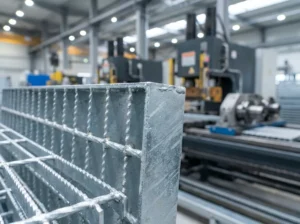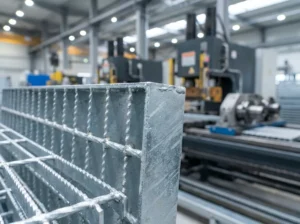
What is Steel Grating?
TL;DR:
Steel grating is a structural grid assembly of bearing bars and cross bars, designed to support heavy loads while permitting the passage of light, air, and liquid. It is the industrial standard for walkways, platforms, and trench covers due to its high strength-to-weight ratio.
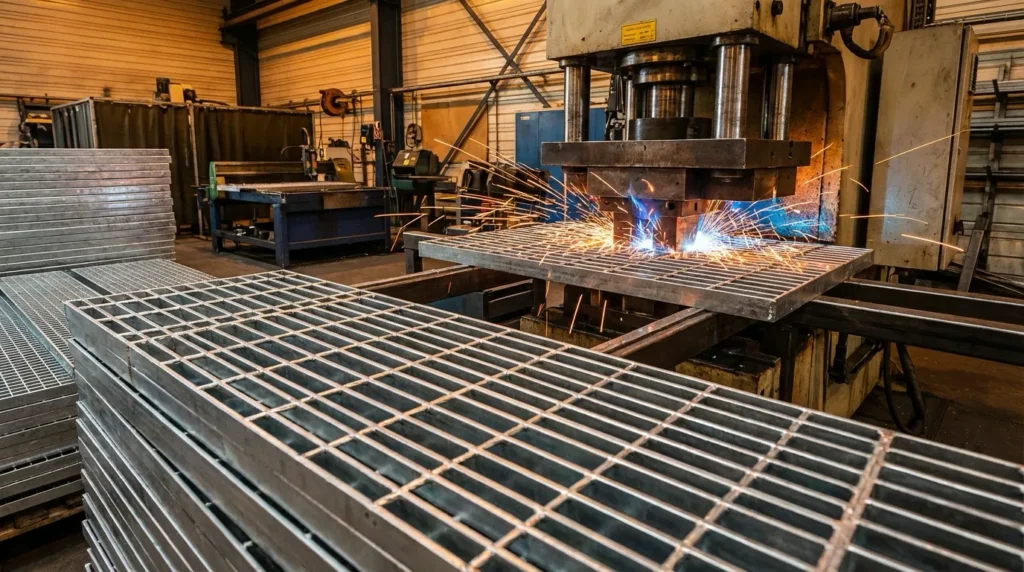
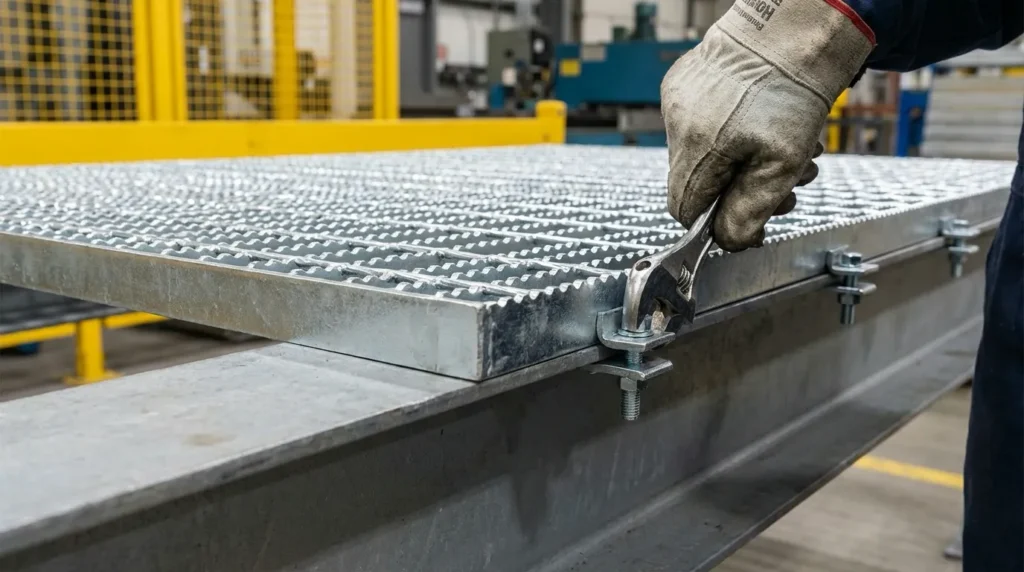
Industrial steel grating features a serrated surface for slip resistance and welded joints for durability.
Definition and Key Components
Steel grating functions as a load-bearing open grid. Its performance relies on the precise fusion of two primary components:
- Bearing Bars: The vertical flat bars that carry the primary load. They run parallel to the span direction.
- Cross Bars: Twisted square rods or flat bars welded perpendicularly across the bearing bars to maintain spacing and provide lateral stability.
Common Variants and Specifications
| Variant | Key Feature | Typical Application |
| Standard Welded | Fusion-welded joints | General industrial walkways |
| Press-Locked | Clean, smooth flush surface | Architectural facades, pedestrian zones |
| Serrated | Notched bearing bars | Oily or wet environments (Offshore) |
| Heavy-Duty | Thicker/deeper bars | Airports, ports, truck terminals |
Performance and Reliability
Grating is specified for its load capacity (ranging from pedestrian to vehicular) and corrosion resistance (typically via Hot-Dip Galvanizing to ASTM A123). Manufacturers must adhere to strict dimensional tolerances to ensure safe installation.
| Manufacturer Capability: Hebei ShunboReliable supply is critical for large-scale infrastructure. Data from Hebei Shunbo highlights the scale required for major projects:Capacity: 120+ tons/day across 4 automated lines.Volume: 35,000 tons produced annually.Experience: 15 years serving 3,000+ customers globally. |
How to Install Steel Grating
TL;DR: Correct installation ensures structural integrity and safety. Verify spans, use the correct clips (Type A/B/C), and strictly follow the “Bearing Bar Direction” rule.
Installation Procedure
Preparation: Verify support steelwork is level. Check grating panels against the layout drawing. Confirm the span direction matches the bearing bars.
Positioning: Lay panels loosely to check fit. Ensure a 5-10mm expansion gap between panels.
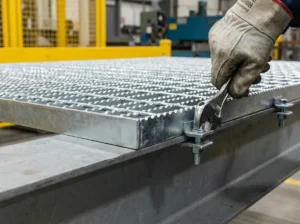
Fixing: Secure panels using Saddle Clips (removable) or tack welding (permanent). Install at least 4 clips per panel.
Inspection: Check for “rocking” panels. Verify all clips are tightened and no trip hazards exist (max 4mm height difference).
Safety & QA Checklist
Common installation mistakes can lead to failure. Use this checklist:
- Orientation: Are bearing bars spanning between supports? (Wrong orientation = Collapse risk).
- Support: Is there at least 25mm of bearing support on the steel beam?
- Edge Banding: Are cut edges banded and fully welded?
How Much is Steel Grating?
Pricing for steel grating is dynamic, driven by raw material indices (Steel, Zinc) and processing complexity. It is typically quoted per square meter ($/m²) or per ton ($/ton).
Primary Cost Drivers
| Factor | Impact | Note | |
| Material Grade | High | Stainless Steel (304/316) is 3-4x the cost of Carbon Steel. | |
| Bar Thickness | High | Heavier bars increase weight/m², directly raising cost. | |
| Galvanizing | Medium | Zinc thickness adds cost but extends life by 20+ years. | |
| Custom Shapes | Medium | Curved cuts and toe plates add labor costs. | |
| Commercial Terms ExampleWhen importing from major hubs like Hebei, China:Port: Tianjin Xingang (Common export hub).Incoterms: FOB (Free on Board) or CIF (Cost, Insurance, Freight).Payment: Typically T/T (30% deposit) or L/C for large orders. | |||
How to Design Steel Grating
Design involves selecting the right bar size and pitch to handle specific loads over a given span without excessive deflection (usually limited to Span/200 or 4mm).
Design Parameters
- Load Class: Define if the load is Pedestrian (3-5 kPa), Light Vehicle (1.5 tons), or Heavy Truck (H20/H25).
- Span (L): The clear distance between supports. As span increases, bearing bar depth must increase.
- Pitch: Standard pitches are 30mm (industrial) or 40mm (mining). 30mm is often required for ANSI compliance.
| Engineer’s Checklist for Fast ServiceHebei Shunbo can provide same-day CAD drawings if the following inputs are provided:Clear Span dimensions.Required Load Capacity (kN/m² or Point Load).Environment (Indoor/Dry or Outdoor/Corrosive). |
How is Steel Grating Made?
Modern manufacturing transforms raw steel coils/bars into rigid panels through a highly automated 5-step process. Speed and consistency are key.
Manufacturing Process
Raw Material Inspection: Steel flat bars are checked for thickness and chemical composition (Mill Certs).
Press-Welding: A high-voltage current fuses the cross bar into the bearing bar under 100+ tons of pressure. This creates a single-piece structure.
Cutting & Banding: Large panels are cut to project size. Open ends are welded with a “band” bar.
Surface Treatment: Panels undergo Hot-Dip Galvanizing (450°C zinc bath) for corrosion protection.
Final QA: Inspection of zinc thickness (typ. 65-85 microns) and dimensions before bundling.
Automated press-welding ensures consistent joint strength and dimension.
What is Steel Grating Used For?
Steel grating is ubiquitous in industrial sectors due to its ability to handle high loads while allowing 80% open area for light and air.
Key Applications
| Industrial PlatformsUsed in power plants, refineries, and factories for elevated walkways. The open grid prevents fume buildup and allows sprinkler water to pass through. | Drainage & Trench CoversHeavy-duty grating covers municipal and industrial drains, allowing rapid water runoff while supporting vehicle traffic. |
Other Sectors: Offshore Rigs (Serrated for grip), Wastewater Treatment (FRP or Stainless for corrosion), and Logistics Centers (Mezzanine flooring).
What is Steel Bar Grating?
TL;DR: “Bar Grating” is the specific technical term for an open grid assembly made of metal bars, distinguishing it from expanded metal or perforated plates.
Comparison: Bar Grating vs. Alternatives
| Feature | Bar Grating | Expanded Metal |
| Structure | Welded separate bars | Slit and stretched sheet |
| Load Capacity | Very High (Structural) | Low to Medium |
| Surface | Flat or Serrated | Raised diamond pattern |
| Primary Use | Flooring, Traffic | Guards, Fencing, Light Walkways |
What is Stainless Steel Grating?
Stainless steel grating (Grades 304 or 316) offers superior hygiene and corrosion resistance compared to galvanized carbon steel. It is the mandatory choice for food processing, pharmaceuticals, and extreme marine environments.
Material Selection Guide
- SS304: General purpose corrosion resistance. Suitable for kitchens, dairies, and most chemical plants.
- SS316: Enhanced resistance to chlorides and acids. Essential for offshore oil rigs and coastal facilities.
| Total Cost of Ownership (TCO)While Stainless Steel costs 3-4x more upfront than Galvanized Steel, its lifespan in corrosive zones is indefinite without maintenance. Galvanized steel may require replacement every 5-10 years in harsh acid environments, making Stainless the cheaper long-term option. |